
Landlocked Countries MCQs | PDF Free Download

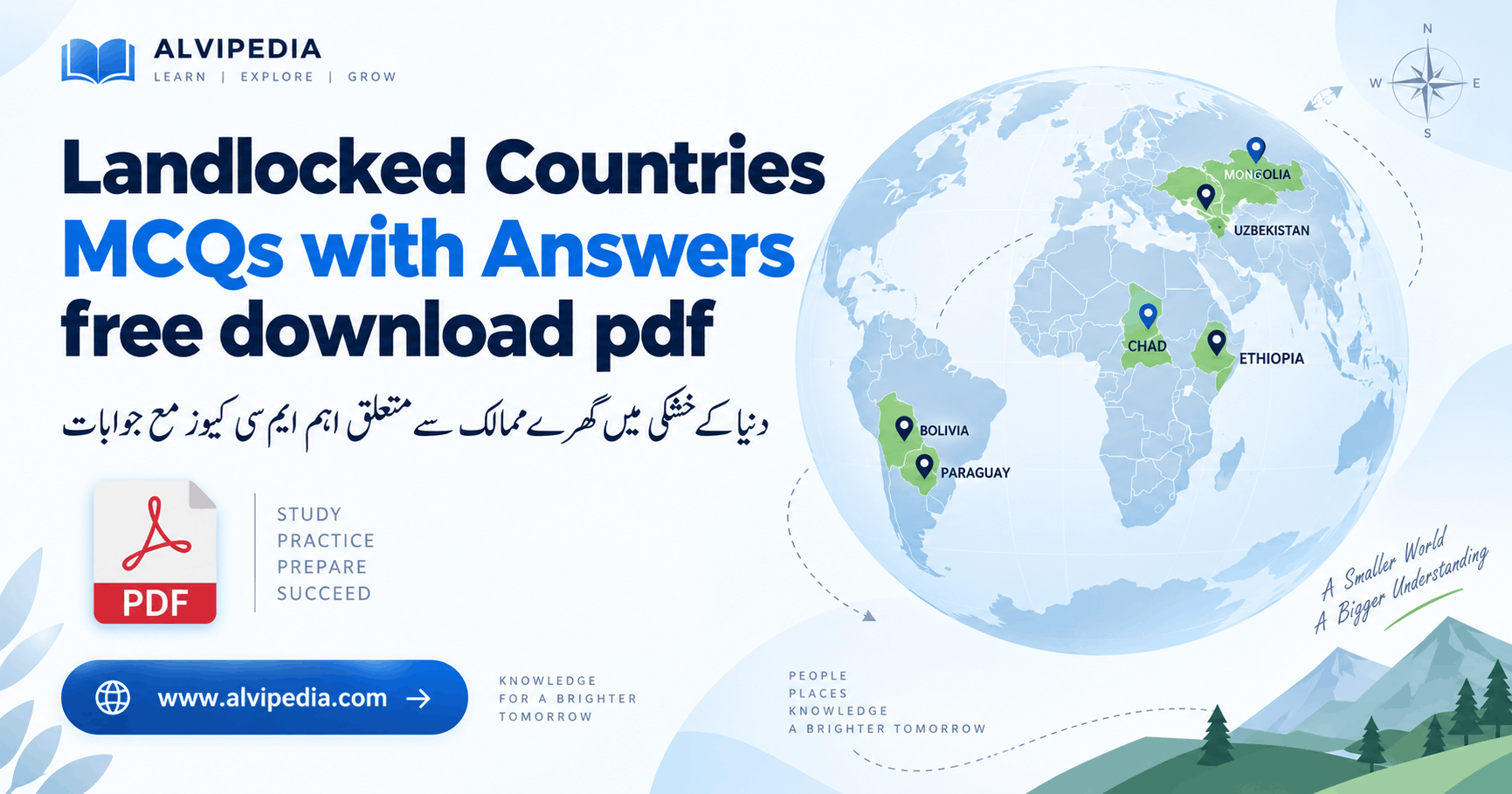
Landlocked countries MCQs are essential for competitive exam preparation. Understanding which countries have no coastline and their geographic characteristics will help you ace general knowledge and geography sections. This comprehensive guide covers all 50 crucial questions about landlocked nations worldwide, from Kazakhstan to Bolivia, helping you master this important geography topic.
1. How many countries are landlocked in the world?
2. How many countries are landlocked in Asia continent?
3. How many landlocked countries are there in Europe continent?
4. Which is the largest landlocked country in the world?
5. How many landlocked countries are located in South America continent?
6. How many landlocked countries are there in Africa continent?
7. Which of the following continents has no landlocked country?
8. Which of the following countries is not landlocked?
9. Which of the following countries is landlocked country?
10. Which is the third largest landlocked country in the world?
11. Which neighbour country of Pakistan is called landlocked country?
12. A country which has no coastline is called
13. How many countries are double landlocked countries in the world?
14. How many semi-landlocked countries are in the world?
15. Which country got landlocked status on 28th June 2006?
16. Which continent’s countries have their own seaports?
17. Which is the second largest landlocked country in the world?
18. A landlocked country in Africa is
19. Which are the only two Doubly Landlocked Countries?
20. Landlocked country in East central Europe is
21. Which country allowed Nepal to use its ports ending Indian monopoly?
22. Which landlocked country borders the most countries?
23. Which is the landlocked capital city of Australia?
24. Which landlocked country is known as the “Land of Thunder Dragons”?
25. Nepal is a landlocked country in which region?
26. Which landlocked country has the highest altitude?
27. Ethiopia is not a landlocked country due to its access to which body of water?
28. Which landlocked country is in the Balkans?
29. Which landlocked country is known for watches and chocolate?
30. Which landlocked country is the smallest in South America?
31. Turkey is not landlocked because it has coastlines on
32. Which landlocked country borders both India and China?
33. Uzbekistan is called doubly landlocked because
34. Which landlocked African country is one of the largest by area?
35. How many landlocked countries are in Central Asia?
36. Ethiopia was the only African nation never colonized except for
37. Which landlocked country hosted the Winter Olympics in 2014?
38. Which landlocked country is the richest in resources?
39. Which landlocked country is known for its mountains and biodiversity?
40. Lesotho is completely surrounded by which country?
41. Vatican City and San Marino are landlocked countries in which region?
42. Which landlocked country is famous for wine production?
43. Which landlocked country shares the border with 8 other countries?
44. Which landlocked country is the highest in the world by altitude?
45. Which landlocked country has a capital city on the Danube River?
46. Which landlocked country is known for its musical heritage?
47. Andorra is located between which two countries?
48. Which landlocked country is located entirely in Africa?
49. Which landlocked country has the largest population?
50. Which landlocked country is the smallest by area?
Understanding Landlocked Countries: A Complete Geography Guide
Understanding landlocked countries MCQs requires more than memorizing numbers—it demands a grasp of geography, geopolitics, and economic implications. Landlocked countries face unique challenges, including limited access to international trade, higher transportation costs, and strategic dependencies on neighboring nations. This guide explores the geography, distribution, and key characteristics that make landlocked countries significant in global affairs.
Largest Landlocked Countries by Area
| Rank | Country | Area (km²) | Continent |
|---|---|---|---|
| 1 | Kazakhstan | 2,724,900 | Asia |
| 2 | Sudan | 1,861,484 | Africa |
| 3 | Mongolia | 1,564,110 | Asia |
| 4 | Chad | 1,284,000 | Africa |
| 5 | Niger | 1,267,000 | Africa |
Note: These figures represent the top 5 largest landlocked countries, accounting for significant global land area despite having no ocean access.
💡 Pro Tip for Exam Preparation
When memorizing landlocked countries, group them by continent rather than memorizing randomly. Africa has 16 landlocked nations, Asia has 13, and Europe has 16. This systematic approach makes it easier to recall during exams and helps build a geographic understanding of global distribution patterns.
Key Characteristics of Landlocked Countries
- Limited Trade Access: Landlocked countries depend entirely on neighboring nations for international commerce, often paying higher transport costs.
- Strategic Vulnerability: Their geopolitical position depends heavily on relationships with bordering countries.
- Economic Constraints: Developing landlocked nations struggle with poverty at rates 1.5 times higher than coastal countries.
- Tourism Potential: Many landlocked countries offer mountains, nature reserves, and cultural heritage attractions.
- Resource Richness: Countries like Kazakhstan and Zambia are resource-rich but face export challenges.
Landlocked Countries Distribution by Continent
Africa
16 Landlocked Countries
Chad, Niger, Sudan, Mali, Burkina Faso, Ethiopia, Zambia, Zimbabwe, Botswana, Malawi, Lesotho, Rwanda, Burundi, Uganda, Central African Republic, South Sudan
Asia
13 Landlocked Countries
Kazakhstan, Uzbekistan, Turkmenistan, Tajikistan, Kyrgyzstan, Mongolia, Afghanistan, Nepal, Bhutan, Laos, Myanmar (Burma), Timor-Leste, Pakistan (historically)
Europe
16 Landlocked Countries
Switzerland, Austria, Hungary, Czech Republic, Slovakia, Poland (historically), Belarus, Serbia, Bosnia and Herzegovina, Montenegro, North Macedonia, Kosovo, Andorra, Liechtenstein, San Marino, Vatican City
Others
1 Landlocked Country
Bolivia & Paraguay in South America. North America, South America, and Australia have no landlocked countries
Geographic Distribution of Landlocked Countries
Doubly Landlocked Countries: A Unique Phenomenon
Only two countries in the world are “doubly landlocked”—meaning they are surrounded exclusively by other landlocked countries. These are Liechtenstein (in Europe, bordered only by Switzerland and Austria) and Uzbekistan (in Central Asia, surrounded by Kazakhstan, Kyrgyzstan, Tajikistan, Afghanistan, and Turkmenistan).
📌 Key Insight
Being doubly landlocked creates exceptional logistical challenges. Exports from Liechtenstein and Uzbekistan must pass through at least two countries to reach the ocean, making them critically dependent on stable regional relationships.
Semi-Landlocked Countries
Seven countries are classified as “semi-landlocked” because they have less than 5% of their borders as coastline. These include Estonia, Latvia, Lithuania, Azerbaijan, Turkmenistan, Mongolia, and the British Indian Ocean Territory. They face coastline disadvantages similar to fully landlocked nations despite technically having sea access.
Frequently Asked Questions: Landlocked Countries
Conclusion: Mastering Landlocked Countries Geography
Landlocked countries MCQs test your understanding of global geography, economic patterns, and geopolitical relationships. With 46 landlocked nations distributed across continents, understanding their characteristics—from Kazakhstan’s resource wealth to Liechtenstein’s banking prominence to Nepal’s strategic positioning between giants—gives you a comprehensive grasp of this geography topic.
The key to acing these questions is recognizing continental patterns, memorizing the doubly landlocked countries, and understanding the economic implications of being without coastal access. Practice these 50 MCQs systematically, learn from the answer explanations, and you’ll master this essential competitive exam topic. Remember that landlocked doesn’t mean disadvantaged—countries like Switzerland prove that strategic positioning, specialized economies, and international cooperation can overcome geographic limitations.
For competitive exams targeting Pakistan’s education system, revision of these landlocked countries questions ensures strong performance in general knowledge sections. Focus on Afghan borders, China-Nepal relationships, Indian transit agreements, and the unique cases of Liechtenstein and Uzbekistan for maximum exam success.
Additional Learning Resources
Expand your geographic knowledge with these related topics:
- Geographic Concepts Video – Understanding Physical Geography
- Geometry of the Universe MCQs – Related Geography Topic
- Alvipedia General Knowledge Portal – Your Complete Exam Preparation Platform
Disclaimer: This guide is designed for educational purposes and competitive exam preparation. All information has been compiled from reliable geographic and geopolitical sources. Alvipedia recommends consulting official geography textbooks and current geopolitical analyses for additional depth on landlocked countries’ evolving roles in global affairs.