
Countries Old and New Names MCQs | PDF Free Download

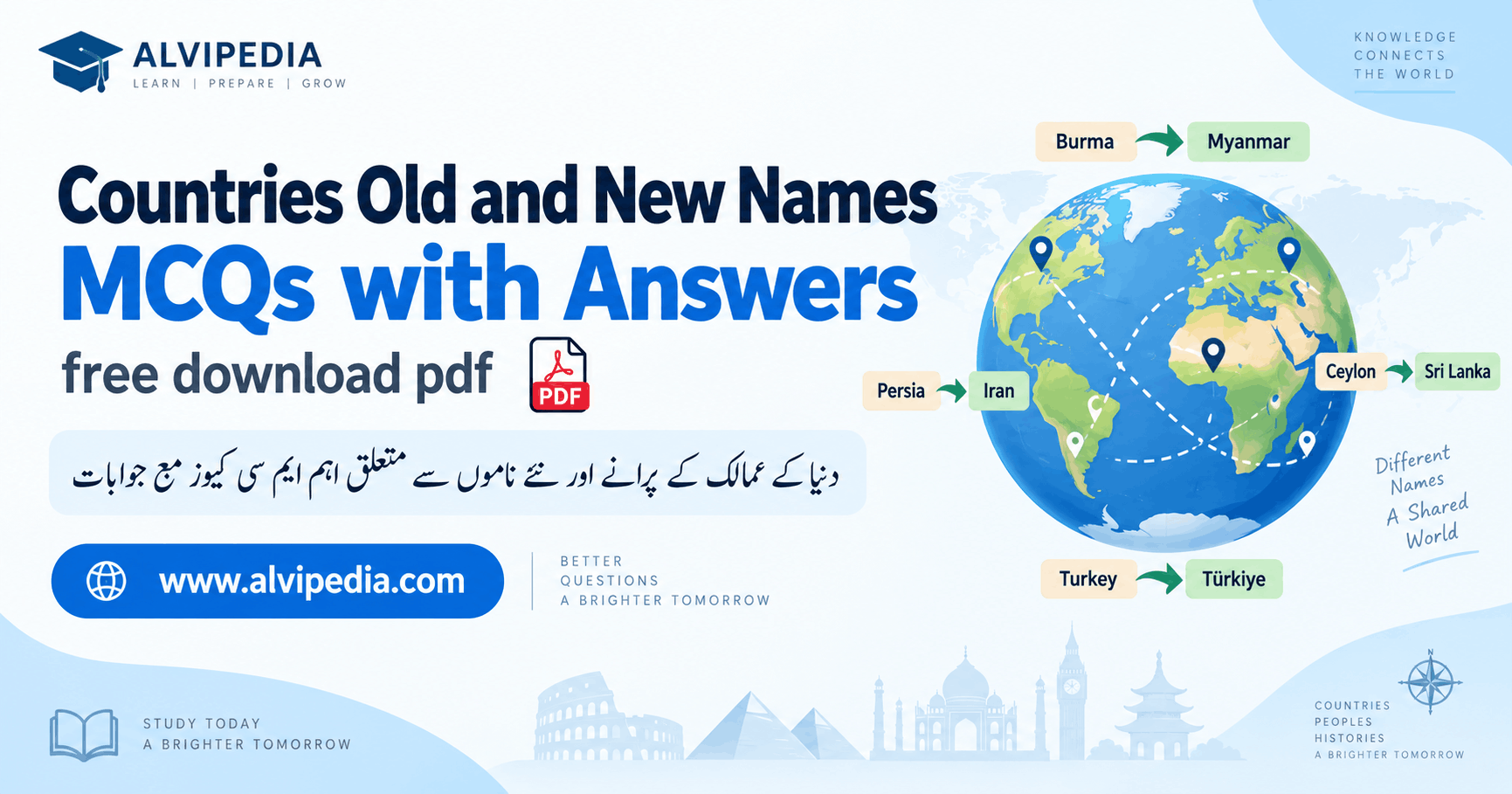
Countries old and new names MCQs cover one of the most classic sections of any Pakistani general knowledge paper, and this practice set of eighty questions, each with a short explanation, walks through the renamed countries and cities examiners keep coming back to.
1. Cambodia was earlier known as:
2. Rhodesia's new name is:
3. Belize was formerly known as:
4. Abyssinia is the old name of which of the following countries?
5. Indonesia was formerly known as the:
6. Botswana is the new name of:
7. Constantinople is the old name of:
8. Vanuatu was formerly known as:
9. Myanmar is the new name of:
10. New name of British Guiana is:
11. Anuradhapura was:
12. Sri Lanka is the new name of:
13. Oslo is the capital of Norway. What is its old name?
14. Congo is the old name of:
15. Surinam is the new name of:
16. Kalaallit Nunaat is the new name of:
17. Loro Sae is the new name of:
18. Formosa is the old name of:
19. Ghana is the new name of:
20. The Netherlands is informally, though imprecisely, referred to by which older nickname?
21. New name of Nippon is:
22. Kinshasa is the new name of:
23. Zaire is the old name of which present-day country?
24. Malaysia is the new name of:
25. Manchukuo is the old name of:
26. Iraq is the new name of:
27. Zambia is the new name of:
28. Nyasaland is the old name of:
29. Leningrad is the new name of:
30. Beijing is the new name of:
31. Hispaniola is closely associated with which of these countries?
32. Ho Chi Minh City is the new name of:
33. Salisbury is the old name of:
34. Hawaiian Islands is the new name of:
35. Thailand is the new name of:
36. Namibia is the new name of:
37. Volgograd is the new name of:
38. Tanzania's name partly derives from the island of:
39. Old name of Faisalabad is:
40. Libya was known as which of the following during the period of Italian colonial rule (1911 to 1943)?
41. New name of Persia is:
42. 'Wien' is the German-language name for which European capital city?
43. What is the new name of Bombay?
44. 'Koln' is the German name for the city known in English as:
45. Helvetia is the old name of:
46. 'Magyar' is the term Hungarians use for their own nationality and language. Which country does it refer to?
47. Campbellpur is the old name of which Pakistani city?
48. Ajodhan is the old name of which Pakistani city?
49. What is the old name of Sahiwal?
50. Peshawar was known in ancient times by which Sanskrit-derived name?
51. Burkina Faso is the new name of:
52. Kinshasa and Brazzaville face each other across a river as the capitals of two different countries. Brazzaville is the capital of:
53. St. Petersburg, Russia, was known by which name during the Soviet era?
54. The new name of East Pakistan is:
55. Which African country was formerly called French Sudan?
56. Which Asian capital city was known as Batavia until 1949?
57. North Macedonia was formerly known simply as:
58. Eswatini was formerly known as:
59. Turkey requested to be known internationally by which native-language name starting in 2022?
60. Benin was formerly known as:
61. Lesotho was formerly known as:
62. Cabo Verde is the official name, adopted in 2013, that replaced which English version?
63. Guinea-Bissau was formerly a colony known as:
64. Equatorial Guinea was formerly known as:
65. Djibouti was formerly known as:
66. Before oil wealth transformed the region, the United Arab Emirates was known as a group of sheikhdoms called the:
67. Mexico's early Spanish colonial name was:
68. New York City's original Dutch colonial name was:
69. Tokyo's name before 1868 was:
70. Somalia's northern region was historically governed as:
71. The Democratic Republic of the Congo was also known, at an earlier point in its history, as the:
72. Which East African territory was known as Tanganyika before merging with Zanzibar to form Tanzania?
73. Which region became independent from Ethiopia in 1993, after a long war, taking Ethiopia's Red Sea coastline with it?
74. Which historical province was partitioned in 1947 into a mostly Muslim eastern half, which later became East Pakistan and then Bangladesh, and a mostly Hindu western half that remained part of India?
75. Sikkim, once an independent kingdom, became a state of which country in 1975?
76. Which Indian city was known as Madras until 1996?
77. Which Indian city was known as Calcutta until 2001?
78. Which former Portuguese colony, the largest of India's former Portuguese territories, was annexed by India in 1961?
79. Mumbai, previously known as Bombay, is believed to take its current name from:
80. Zimbabwe takes its name from 'Great Zimbabwe,' which refers to:
Why country names change, and why exams love asking about it
Countries old and new names MCQs turn up in almost every Pakistani general knowledge paper, and for good reason: a renamed country packs a whole story, independence, a political shift, or a deliberate rebrand, into a single fact that is easy to test and easy to get wrong if you only half remember it.
Most renamings follow a recognizable pattern once you see enough of them. Colonial names gave way to local ones after independence. Some governments rebranded a country for political reasons decades later. A smaller group of cases are not really renamings at all, just a country’s own name in its own language, which is exactly the kind of nuance this set is built to cover.
Pakistan’s own general knowledge tradition leans heavily on this topic for a reason. A country’s list of old and new names doubles as a shorthand history of decolonization, told one renamed place at a time, which makes it genuinely useful knowledge rather than trivia for its own sake.
Five patterns behind a name change
Not every old-name question works the same way. Sorting a rename into one of these five categories often makes the underlying fact easier to remember.
| Pattern | What drove it | Example |
|---|---|---|
| Post-independence rename | A colonial-era name dropped once a country gained independence | Gold Coast to Ghana, Ceylon to Sri Lanka |
| Political rebrand | A government-led renaming long after independence | Burma to Myanmar, Zaire to Congo |
| Recent rebrand | A deliberate, often symbolic renaming within the past decade | Swaziland to Eswatini, Macedonia to North Macedonia |
| Native-language name | A country’s own name for itself, not a retired name at all | Nippon for Japan, Magyar for Hungary |
| City-level rename | A city renamed separately from its country | Bombay to Mumbai, Calcutta to Kolkata |
The fourth row trips up more students than any other. A native-language name is not a fact about history changing, it is simply a fact about language, and treating it like a retired old name is the single most common mistake in this topic.
Recognizing the category also helps when a name looks unfamiliar. A question naming an obscure colonial-sounding territory almost always points toward the post-independence category, while one asking about a country’s own word for itself points toward the native-language category instead.
Not every country fits neatly into a single row either. Zaire touches both the political rebrand row, since the government chose the new name deliberately in 1971, and the reversal row a generation later, when the same country moved away from Zaire and back toward a Congo-based name in 1997.
Renaming comes in waves
Country renamings are not evenly spread across history. They cluster around a handful of periods, each driven by a different kind of political change. The bars below give a rough sense of how much renaming activity happened in each period, based on the names covered in this set.
The 1960s wave dwarfs the others for a clear reason: dozens of African and Asian countries gained independence within a single decade, and renaming a country was often one of the first acts of a new government. The more recent wave, from the 2010s onward, is smaller but tends to attract more news coverage, since it involves countries already well established on the world stage choosing to rebrand rather than gaining independence for the first time.
Reading the chart this way also explains why some decades feel almost empty. Renaming a country takes political will and a specific triggering event, independence, a revolution, a symbolic anniversary, so quiet decades usually mean fewer of those triggering moments rather than any lack of countries willing to change.
Why Pakistan renamed several of its own cities
Pakistan renamed several of its own cities after independence, mostly moving away from names tied to British colonial officials.
Lyallpur, named after a British lieutenant governor, became Faisalabad in 1979, honoring Saudi King Faisal for his support of Pakistan. Montgomery, named after a British field marshal, became Sahiwal. Campbellpur, named after a British colonel, became Attock in 1978, reverting to a name tied to the historic Attock Fort on the Indus River.
Not every old Pakistani place name has colonial roots, though. Pakpattan’s older name, Ajodhan, predates British rule entirely, tied instead to the region’s history before colonization and to the shrine of Baba Farid. Recognizing which category a Pakistani city name falls into, a colonial-era rename or an older pre-colonial name, is often enough to work out the right answer even when the specific city is unfamiliar.
This pattern, dropping colonial names in favor of ones with local historical or religious significance, mirrors what happened across many newly independent countries in the decades after 1947, well beyond Pakistan’s own borders.
Old names that refuse to disappear
A retired country name rarely vanishes completely. It often survives in everyday language long after the official name has changed, which is exactly the kind of detail exam writers enjoy testing.
- Burma is still used informally, even though Myanmar has been the official name since 1989.
- Holland remains a common nickname for the Netherlands internationally, despite referring to only two of its provinces.
- Ceylon survives in product names such as Ceylon tea, long after the country itself became Sri Lanka.
- Persia lives on in cultural terms like Persian cats and Persian rugs, even though the country has been Iran since 1935.
- Siamese, from Siam, remains the standard term for a cat breed and for conjoined twins, despite the country renaming itself Thailand in 1939.
- Bombay survives in the name Bollywood, India’s Mumbai-based film industry, even though the city has officially been Mumbai since 1995.
None of this makes the old name correct on a modern exam. It just explains why an old name can feel oddly familiar even to students who have never studied this topic before.
Brand names and product names change far more slowly than official geography, since renaming a product or a company is its own separate decision. That gap between what a government calls a place and what a label or a habit still calls it is where a surprising number of these old names survive.
Eight renamings, laid out on a timeline
Seeing a handful of renamings placed in order sometimes makes the pattern click faster than a list ever could. The timeline below lines up eight well-known examples from 1935 to 2019, old name crossed out, new name below it.
Notice how the gaps are not even. Long quiet stretches sit between bursts of renaming activity, usually tied to a wave of independence movements or, more recently, a handful of governments choosing to rebrand within a few years of each other.
A timeline like this one is also a useful memory aid on its own. Anchoring a renamed country to a rough decade, even without the exact year, is often enough to eliminate two or three wrong options on a multiple-choice question before the correct answer even needs to be recalled directly.
Old name, new name, or just a different language?
A meaningful share of the trickiest questions in this topic are not really about renaming at all. They are about the difference between a country’s name in English and its name in its own language, a distinction that gets flattened into old-name-versus-new-name phrasing far too often.
Japan calls itself Nippon, or Nihon, in Japanese, and always has. Hungary calls itself Magyarorszag, with Magyar as the root word for the people and language, and always has. Austria’s capital has always been Wien in German, the same city English speakers call Vienna. None of these are retired names waiting to be replaced. They are simply what the word looks like in a different language, existing side by side with the English version rather than one following the other in time.
The genuine renamings in this set, Ceylon to Sri Lanka, Burma to Myanmar, Swaziland to Eswatini, work differently. In each of those cases, the older name was in active use, then a specific decision at a specific point in time replaced it. Telling the two categories apart is often the real skill being tested, more than memorizing the country pairs themselves.
A useful check is to ask whether the two names come from the same language or two different ones. Ceylon and Sri Lanka are both English-language names used at different points in time, a genuine rename. Nippon and Japan are the same place in two different languages, used at the same time by different speakers, not a rename at all.
Common old and new names mix-ups worth clearing up
A handful of assumptions trip up students often enough in countries old and new names MCQs that they deserve a direct answer.
Congo’s naming history is often flattened into a single clean swap, when it moved through several stages: the Congo Free State, the Belgian Congo, independence as Congo, a rename to Zaire in 1971, and a reversion to a Congo-based name in 1997. Depending on which stage a question targets, more than one answer can look plausible.
Tanzania is often assumed to be a simple renaming of one earlier territory, when it was formed by merging two: mainland Tanganyika and the island of Zanzibar, in 1964.
Finally, a retired name is sometimes assumed to be gone entirely once a country officially changes it. In practice, informal use often continues for decades, in product names, cultural terms, and everyday conversation, even after the new name becomes standard on exams and official documents.
A related trap involves assuming a rename only ever moves in one direction. Leningrad reverted to St. Petersburg after decades under the Soviet-era name, and the Congo-based name eventually returned after the Zaire period ended, proof that a country’s naming history does not always move forward in a straight line.
Why this topic keeps showing up in exams
Pakistan’s major competitive exams, including PPSC, FPSC, NTS, and CSS, treat old and new country names as a dependable general knowledge category, since it rewards genuinely broad reading rather than a narrow memorized list. A single well-built countries old and new names MCQs set tends to stay useful across several exam cycles, since the underlying history does not change even when the exact questions do.
Vocabulary is worth building alongside history, a little at a time rather than in one cram session. This English vocabulary playlist pairs well with general knowledge revision for exactly that reason. For broader preparation, alvipedia’s PPSC exam guide rounds up related general knowledge material that pairs naturally with a history-heavy set like this one.
A well-built MCQs set is also useful simply as a study habit. Working through eighty questions in smaller batches, then returning a few days later to whichever ones got marked wrong, tends to stick better than rereading a flat list of old and new names passively from a textbook.
Old and new names rarely appear as an isolated topic either. A single paper might ask about a country’s former name in one question, then pivot to its capital, its continent, or a related current affairs item in the next. Building a broad, connected picture of each country, rather than memorizing name pairs in isolation, tends to pay off across several questions at once rather than just one.
Final word
Country names carry more history than most students expect going in. Behind every Ceylon-to-Sri-Lanka or Burma-to-Myanmar pair sits a real political moment, and behind every Nippon or Magyar sits a language rather than a history lesson at all. Working through these eighty countries old and new names MCQs is a solid way to find out which of those distinctions still feel shaky before an exam does it for you. Revisit whatever you got wrong, read the explanation again, and try the set a second time in a few days.