
Unit Circle Explained: 12 Essential Values, Chart, Table, Diagram, Radians & Sin, Cos, Tan
If you have ever stared at a unit circle diagram and felt your brain freeze, you are not alone. Every year, thousands of Pakistani students preparing for board exams, entry tests, and competitive exams like PPSC, FPSC, and NTS trip over the same handful of angles and values.
The good news? Once you understand the logic behind the unit circle instead of memorizing it blindly, everything from sin, cos, and tan values to radian conversions becomes second nature. In this guide, we will break it down step by step with diagrams, tables, formulas, and practice questions so you can master it for good.
1. What Is a Unit Circle?
A unit circle is simply a circle with a radius of exactly 1 unit, centered at the origin (0, 0) of a coordinate plane. That is the whole definition — nothing complicated about it. What makes it powerful is what it represents: every point on this circle corresponds to an angle, and the coordinates of that point directly give you the cosine and sine values of that angle.
In other words, for any angle θ measured from the positive x-axis, the point where it touches the circle has coordinates (cos θ, sin θ). This single idea is the foundation of the entire unit circle, and it is why trigonometry teachers keep coming back to it again and again.
Students preparing for FSc, ICS, or entry tests will find that almost every trigonometry question — from solving equations to graphing functions — traces back to this one simple circle.
2. Unit Circle Diagram Explained
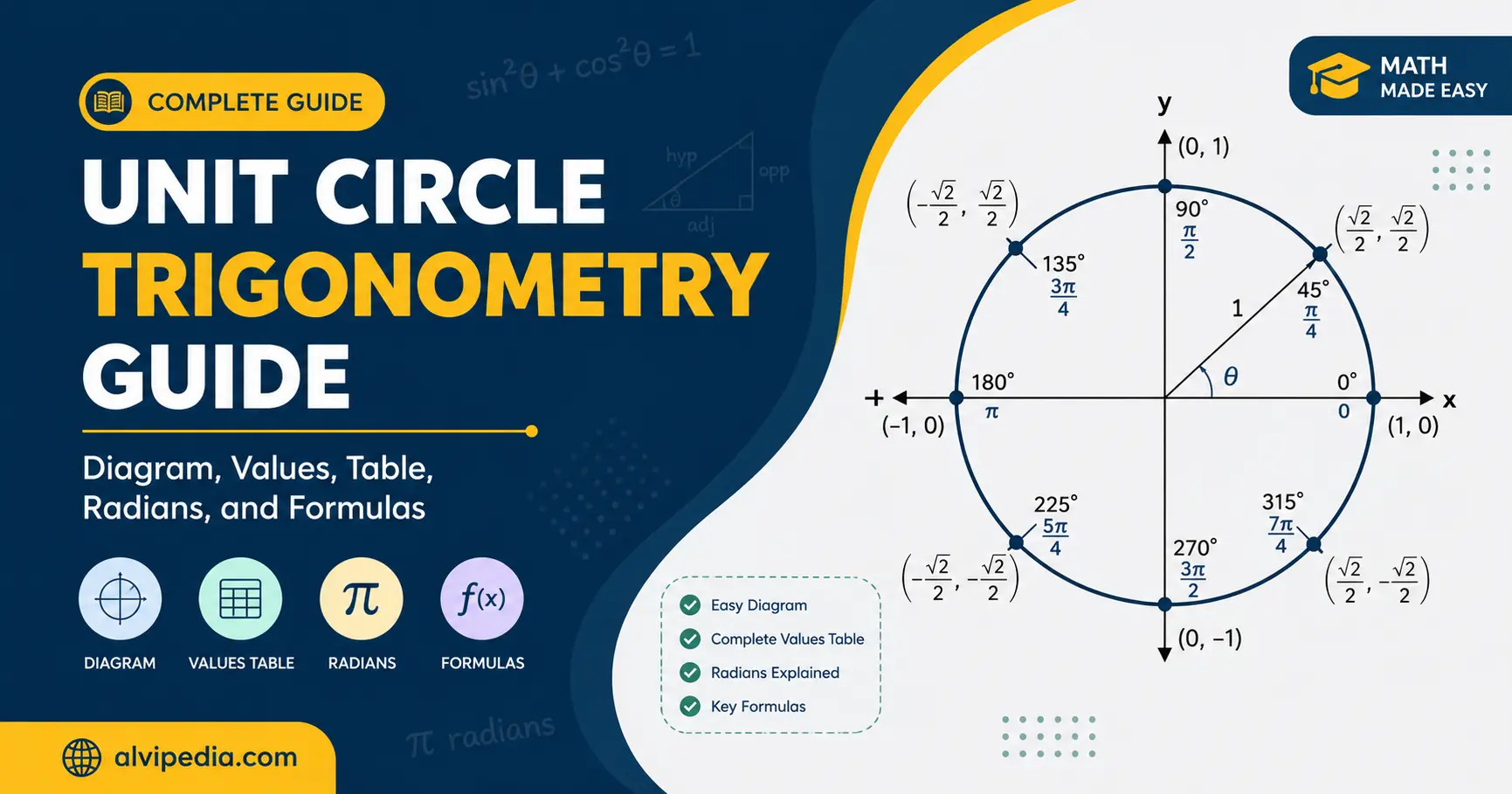
Let’s visualize it. Below is a simplified unit circle showing the four quadrants, the axes, and a sample angle θ with its coordinates marked as (cos θ, sin θ).
Notice how the radius line (called the terminal side of the angle) sweeps counter-clockwise from the positive x-axis. As it rotates, the x-coordinate of the point traces the cosine value, and the y-coordinate traces the sine value. This is the entire mechanism behind the unit circle, visualized in one picture.
3. Degrees vs Radians Conversion
Angles on the unit circle can be measured in degrees or radians, and exam papers frequently switch between the two, so you need to be comfortable converting either way.
Degrees to Radians: multiply by π/180
Radians to Degrees: multiply by 180/π
For example, 180° equals π radians, and 90° equals π/2 radians. Once you memorize this relationship, converting any angle on the unit circle becomes a quick mental calculation rather than a guessing game.
4. Unit Circle Values Table
This is the table students bookmark and revisit the most. It lists the most commonly tested angles along with their sine, cosine, and tangent values.
| Degrees | Radians | sin θ | cos θ | tan θ |
|---|---|---|---|---|
| 0° | 0 | 0 | 1 | 0 |
| 30° | π/6 | 1/2 | √3/2 | 1/√3 |
| 45° | π/4 | √2/2 | √2/2 | 1 |
| 60° | π/3 | √3/2 | 1/2 | √3 |
| 90° | π/2 | 1 | 0 | undefined |
| 180° | π | 0 | -1 | 0 |
| 270° | 3π/2 | -1 | 0 | undefined |
| 360° | 2π | 0 | 1 | 0 |
A handy trick: for 0°, 30°, 45°, 60°, and 90°, the sine values follow the pattern √0/2, √1/2, √2/2, √3/2, √4/2 — and cosine is just the reverse order. This single pattern removes the need to memorize the table by rote.
5. Key Unit Circle Formulas
These are the formulas that show up most often in exams, so keep them close by:
- Pythagorean Identity: sin²θ + cos²θ = 1
- Tangent Identity: tan θ = sin θ / cos θ
- Reciprocal Identities: csc θ = 1/sin θ, sec θ = 1/cos θ, cot θ = 1/tan θ
- Periodicity: sin(θ + 360°) = sin θ, and the same rule applies to cosine
- Co-function Identity: sin(90° − θ) = cos θ
6. Signs of Trig Ratios by Quadrant
Every quadrant of the unit circle gives different signs for sine, cosine, and tangent. Most students remember this using the phrase “All Students Take Calculus,” where each word marks which ratios are positive in that quadrant.
| Quadrant | Angle Range | Positive Ratios |
|---|---|---|
| I | 0° – 90° | All (sin, cos, tan) |
| II | 90° – 180° | sin only |
| III | 180° – 270° | tan only |
| IV | 270° – 360° | cos only |
💡 Pro Tip
Draw the unit circle from memory five times a day for a week. Start with just the four quadrants and axes, then add the special angles one at a time. Muscle memory works faster than flashcards for this topic.
If you want more practice with related concepts, browse our general knowledge section. For an interactive external reference, the Math Is Fun unit circle page is also a great supplementary resource.
7. Fill in the Blanks
- The radius of a unit circle is always _______ unit(s).
- On the unit circle, cos θ represents the _______ coordinate of a point.
- 180° is equal to _______ radians.
- The value of sin 90° is _______.
- The Pythagorean identity states sin²θ + cos²θ = _______.
- In Quadrant III, only _______ is positive.
- tan θ is calculated by dividing sin θ by _______.
Show Answer Key
1. 1 2. x 3. π 4. 1 5. 1 6. tan 7. cos θ
8. MCQ Practice Section
1. What is the radius of a unit circle?
A) 0 B) 1 C) 2 D) π
2. What is the value of cos 0°?
A) 0 B) -1 C) 1 D) undefined
3. Which quadrant has all trig ratios positive?
A) I B) II C) III D) IV
4. 90° in radians is equal to:
A) π B) π/2 C) π/4 D) 2π
5. What is tan 90°?
A) 0 B) 1 C) -1 D) undefined
Show Answer Key
1. B 2. C 3. A 4. B 5. D
9. Practice Problems
- Convert 150° into radians using the unit circle conversion formula.
- If sin θ = 1/2, find two possible values of θ between 0° and 360° using the unit circle.
- Find cos θ if sin θ = 3/5 and θ lies in Quadrant I.
- Determine the sign of tan θ when θ = 200°.
- Convert 5π/6 radians into degrees.
10. Summary
- A unit circle has a radius of exactly 1 and is centered at the origin.
- Any point on it equals (cos θ, sin θ) for the angle θ.
- Degrees convert to radians by multiplying by π/180.
- Special angles 0°, 30°, 45°, 60°, and 90° follow predictable value patterns.
- Signs of sin, cos, and tan change by quadrant, following the “All Students Take Calculus” rule.
Conclusion
The unit circle might look intimidating at first glance, but it is really just a map connecting angles to coordinates. Once you understand how sine and cosine grow out of a simple circle with radius 1, memorizing values becomes far easier, and solving trigonometry questions in exams like FSc, ICS, or PPSC becomes second nature. Keep practicing the diagram, revisit the values table often, and the unit circle will soon feel like second nature rather than a hurdle.
11. FAQs
What is a unit circle used for?
A unit circle is used to define sine, cosine, and tangent values for any angle, making it the foundation for solving trigonometric equations and graphing trig functions.
Why is the radius of the unit circle always 1?
A radius of 1 simplifies calculations, since it makes the coordinates of any point on the circle equal directly to cos θ and sin θ, without needing extra scaling.
How do I memorize the unit circle quickly?
Learn the square root pattern for sine values (√0/2 to √4/2) at 0°, 30°, 45°, 60°, and 90°, then use symmetry to fill in the remaining quadrants.
Is the unit circle only in degrees or only in radians?
Neither — the unit circle works with both. Most higher-level courses prefer radians, but degrees are commonly used in school-level trigonometry in Pakistan.
What is the difference between the unit circle and a regular circle?
A regular circle can have any radius, but a unit circle specifically has a radius of 1, which is what makes its coordinates directly represent trigonometric ratios.
Do PPSC and FPSC exams test unit circle questions?
Yes, basic trigonometric ratios and angle conversions based on the unit circle frequently appear in general science and math sections of PPSC and FPSC tests.