
How to Prepare for PPSC Exam: 10 Proven Tips From Scratch
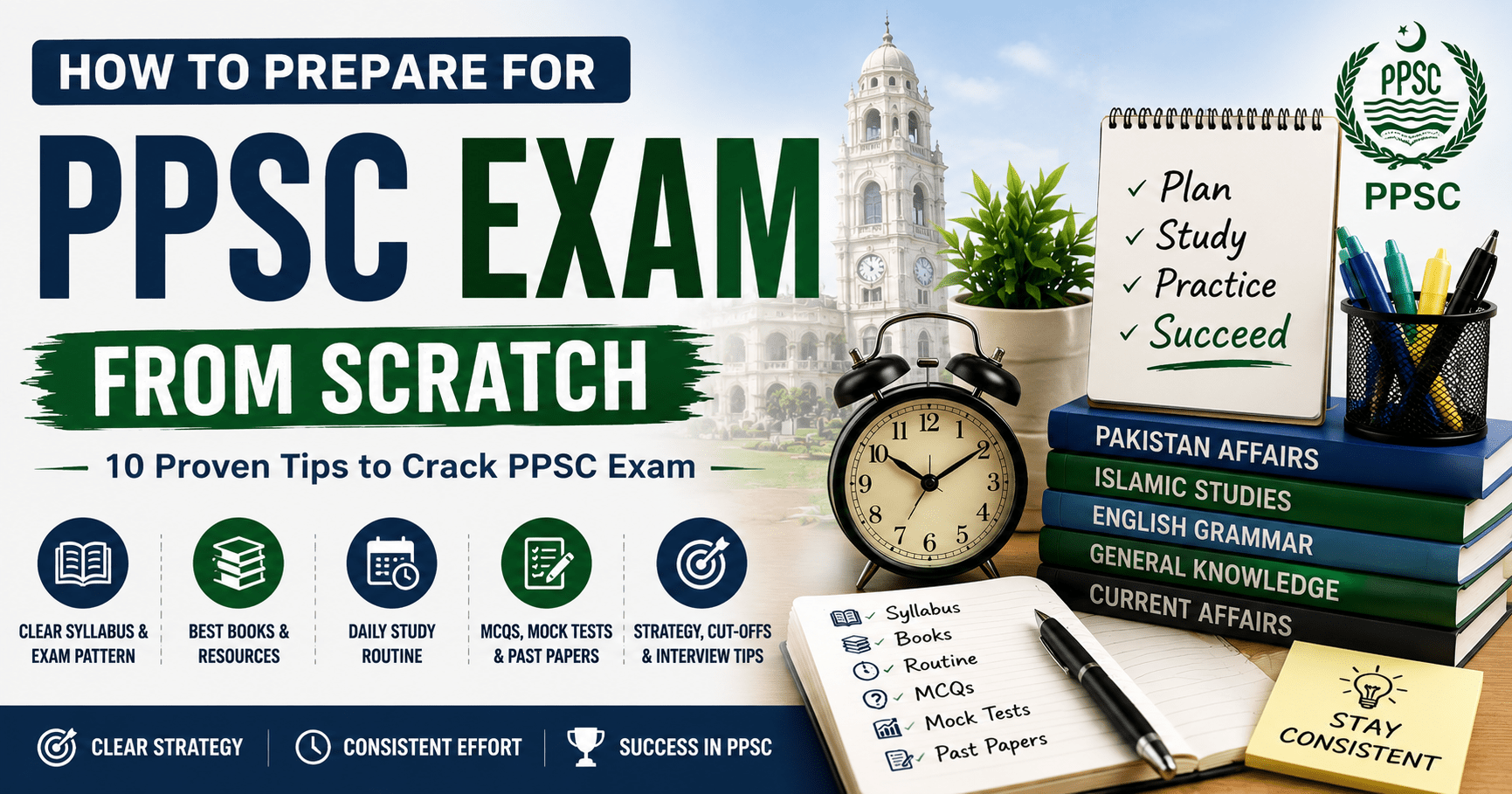
So you’ve decided to go for it — the PPSC exam. Maybe you just graduated, maybe you’re switching careers, or maybe you’ve been eyeing a government job for years and finally said “enough waiting.” Whatever brought you here, welcome. PPSC exam preparation can feel like staring at a mountain with no idea where the trail starts.
Here’s the good news: thousands of candidates have climbed this mountain before you, and there’s a well-worn path. In this guide, we’ll walk through exactly how to build your PPSC exam preparation strategy from absolute zero — syllabus, books, daily routines, mock tests, cut-off marks, and more. No fluff, just what actually works.
Table of Contents
- Understanding the Exam Structure & Syllabus
- Essential Study Resources & Books
- Daily Study Routine
- Practice MCQs and Past Papers
- PPSC PCS Preparation Tips: Expert-Recommended Strategies
- PPSC PCS Recruitment Preparation Tips and Exam Strategy
- Be Clear With the PPSC Exam Pattern
- PPSC Interview Exam Pattern
- Create a PPSC Exam Study Plan
- Work on the Weaker Subjects
- Attempt Mock Tests and Series for PPSC
- Practice Answer Writing For Mains
- PPSC Cut Off Marks
- PPSC Qualifying Marks
- PPSC Previous Year’s Cut Off Marks
- PPSC Previous Year Question Paper
- FAQs
Understanding the Exam Structure & Syllabus
Before you open a single book, you need a map. The PPSC (Punjab Public Service Commission) conducts recruitment exams for a huge range of government positions — from Sub Inspectors and Tehsildars to Lecturers and Assistant Directors. Each post has its own syllabus, but most exams share a core: General Knowledge, Pakistan Studies, Islamic Studies (or Ethics for non-Muslim candidates), Current Affairs, English, and a subject-specific portion related to the post.
Grab the official advertisement and syllabus PDF from the PPSC website the moment it’s released. Read it twice. Highlight topics you’ve never heard of — those are your red flags. A solid PPSC exam preparation journey always starts with knowing exactly what you’re being tested on, not guessing.
“A goal without a plan is just a wish.” — Antoine de Saint-Exupéry. That quote applies perfectly here. Your syllabus is the plan; your study sessions are the execution.
Essential Study Resources & Books
You don’t need fifteen books. You need three or four good ones, read properly, multiple times. Here’s a breakdown of commonly recommended resources for PPSC preparation:
| Subject Area | Recommended Resource | Why It Helps |
|---|---|---|
| Pakistan Affairs | Pakistan Affairs by Ikram Rabbani | Covers history, geography, and constitutional development in one place |
| Islamic Studies | Islamiat MCQs by various publishers (Dogar, Advanced) | Concise, MCQ-format, easy to revise quickly |
| General Knowledge & Current Affairs | Daily newspapers (Dawn, The News) + a monthly current affairs digest | Keeps you updated on recent developments examiners love to test |
| English | English Grammar by Wren & Martin | Strong foundation in grammar rules tested in MCQ sections |
| General Science & Everyday Knowledge | General Science MCQs (Dogar Brothers) | Covers basic science concepts frequently appearing in PPSC papers |
| Practice & Past Papers | Solved past papers from PPSC’s official archive | Shows real question patterns and difficulty level |
Pro Tip: Don’t collect books like trophies. Pick one source per subject, finish it, then move to MCQ practice. Switching between five books on the same topic wastes time and creates confusion.
For candidates also preparing for related competitive exams, our FIA Sub Inspector past papers guide on Alvipedia is a great companion resource since the GK and current affairs portions overlap significantly.
Daily Study Routine
Consistency beats intensity. A candidate who studies 4 focused hours daily for six months will almost always outperform someone who crams 12 hours a day for two weeks before burning out. Here’s a sample routine that balances depth and revision:
- Morning (2 hours): New topic study — Pakistan Affairs, Islamic Studies, or General Science, rotating daily
- Afternoon (1 hour): Newspaper reading and current affairs notes
- Evening (1.5 hours): English grammar and vocabulary practice
- Night (1 hour): MCQ practice on whatever you studied that morning
- Weekly: One full mock test on Sunday, followed by error analysis
Adjust the hours based on your schedule, but protect that structure. Skipping days here and there compounds quickly — three missed days a week means you’ve effectively lost almost half your preparation time.
Practice MCQs and Past Papers
If there’s one habit that separates candidates who clear PPSC from those who don’t, it’s MCQ practice — done right. Reading is passive. Solving MCQs is active recall, and active recall is what your brain needs under exam pressure.
Start solving past papers from week one, even if you feel unprepared. Don’t wait until you’ve “finished the syllabus” — that day rarely comes. Early exposure to real questions tells you what examiners actually focus on, which then shapes how you study everything else.
How to Practice MCQs Effectively
- Time yourself — simulate real exam conditions, not relaxed browsing
- Maintain a separate “mistake notebook” for questions you got wrong
- Revisit that mistake notebook every weekend
- Don’t just memorize the answer — understand why the other three options are wrong
PPSC PCS Preparation Tips: Expert-Recommended Strategies & More
Now that the basics are covered, let’s get into the strategic layer — the stuff that separates a decent score from a top score. These PPSC PCS preparation tips come from successful candidates and senior coaching mentors who’ve seen what consistently works.
1. Don’t Chase Every New Source
Every year there’s a “hot new guide” everyone’s talking about. Ignore the noise. Stick with your core materials and supplement with current affairs only.
2. Revise in Cycles, Not Once
Plan for at least three full revision cycles before your exam. The first reading builds understanding, the second builds recall, and the third builds speed.
3. Build a Current Affairs Habit Early
Current affairs questions often feel “unfair” because they change constantly. The fix isn’t cramming before the exam — it’s a daily 30-minute habit sustained over months.
PPSC PCS Recruitment Preparation Tips and Exam Strategy
PPSC recruitment isn’t a single hurdle — it’s typically a multi-stage process: written test (MCQ-based screening test), and for many posts, a written subjective paper followed by an interview. Your strategy needs to account for all stages from day one, not just the first one.
A common mistake is treating the screening test as the “real” exam and only thinking about the interview after clearing it. By then, you’ve lost months of preparation time for the next stage. Instead, allocate a small weekly slot — even 30 minutes — to interview-related reading (current affairs, general awareness about your chosen department) right from the start.
Be Clear With the PPSC Exam Pattern
Understanding the exam pattern isn’t optional — it directly affects how you allocate your study time. Most PPSC screening tests follow an MCQ-based format with negative marking considerations varying by post. Here’s a general pattern breakdown:
| Component | Typical Weightage | Format |
|---|---|---|
| General Knowledge | 20-25% | MCQs |
| Pakistan Affairs & Current Affairs | 20-25% | MCQs |
| Islamic Studies / Ethics | 10-15% | MCQs |
| English | 10-15% | MCQs |
| Subject-Specific / Professional | 30-40% | MCQs / Subjective (post-dependent) |
Note: weightage varies significantly by post. Always confirm with the latest official advertisement for your specific position.
PPSC Interview Exam Pattern
The interview stage is where many candidates who scored well on paper suddenly stumble — usually because they treated it as an afterthought. PPSC interviews typically assess general knowledge, awareness of current events, communication skills, and suitability for the post.
- Expect questions about your academic background and why you chose this field
- Be ready to discuss current national and international affairs confidently
- Know basic facts about the department you’re applying to
- Practice mock interviews with friends or mentors to reduce nervousness
Pro Tip: Interviewers often ask about your hometown’s basic statistics — population, MPA/MNA, local administration. Candidates who know these small details consistently make a stronger impression.
Create a PPSC Exam Study Plan
A study plan isn’t a rigid timetable carved in stone — it’s a flexible roadmap that keeps you accountable. Start by working backward from your exam date. If you have six months, divide that into three phases:
- Phase 1 (Months 1-2): Foundation building — cover the entire syllabus once, even briefly
- Phase 2 (Months 3-4): Deep revision plus heavy MCQ practice
- Phase 3 (Months 5-6): Full-length mock tests, weak-area targeting, and interview prep
Write this plan down — physically, on paper or in a planner app. There’s something about seeing your plan visually that makes it real and harder to ignore.
Work on the Weaker Subjects
Here’s an uncomfortable truth: most candidates avoid their weak subjects because studying them feels frustrating. But your weak subjects are usually where the easiest marks improvements live, simply because you’re starting from a lower baseline.
Take a diagnostic test in week one. Identify your bottom two subjects. Then deliberately give them 40% more study time than your strong subjects for the first month. You’ll likely see your overall score jump faster than if you’d just kept polishing what you’re already good at.
Attempt Mock Tests and Series for PPSC
Mock tests do something no amount of book reading can: they train your time management and exam-day stamina. Many academies offer PPSC mock test series, both online and in-person.
Why Mock Tests Matter
- They reveal your actual speed under timed conditions
- They expose subject areas you’ve been unconsciously avoiding
- They build the mental endurance needed for a 2-3 hour paper
- They reduce exam-day anxiety because the format feels familiar
Aim for at least one full mock test per week starting two months before your exam, ramping up to two or three per week in the final weeks.
Practice Answer Writing For Mains
For posts that include a written/subjective paper, answer-writing practice is non-negotiable. Knowing the content isn’t the same as expressing it clearly within a word and time limit.
- Practice writing answers within strict time limits — don’t let yourself “finish later”
- Structure answers with a brief intro, body points, and a short conclusion
- Get a mentor or peer to review your handwriting speed and clarity
- Practice essay writing on current national issues at least once a week
PPSC Cut Off Marks
Cut-off marks represent the minimum score required to qualify for the next stage of recruitment. These vary every year based on the number of vacancies, total applicants, and overall paper difficulty. There isn’t a fixed number — but understanding the general trend helps you set a realistic target.
As a rule of thumb, aiming for 65-75% in the screening test gives you a comfortable safety margin for most posts, though highly competitive positions can push cut-offs higher.
PPSC Qualifying Marks
Qualifying marks are the baseline percentage you must score just to be considered — separate from cut-off marks, which determine your actual rank or selection among qualified candidates. Generally, candidates need to score above a minimum threshold (commonly around 40-50%, but always check the specific advertisement) just to have their paper considered for merit calculation.
Important: Qualifying marks and cut-off marks are often confused. Qualifying marks = the minimum to “pass.” Cut-off marks = the minimum to actually be selected, which is usually higher.
PPSC Previous Year’s Cut Off Marks
Reviewing previous years’ cut-off trends gives you a benchmark, even though exact figures shift annually. Generally, cut-offs have shown a gradual upward trend over recent years as more candidates compete for the same number of seats — meaning the “safe zone” target keeps getting slightly higher each cycle.
Rather than fixating on an exact number from two years ago, use the trend direction: if cut-offs have been climbing, aim a few percentage points above last year’s figure for your target post.
PPSC Previous Year Question Paper
Previous year papers are arguably the single most valuable resource in your entire PPSC exam preparation toolkit. They show you real question phrasing, difficulty calibration, and recurring themes that no guidebook can fully replicate.
- Download papers from the official PPSC website’s archive section
- Solve at least 3-5 years of papers for your specific post category
- Note repeated topics — examiners often return to favorite themes
- Check our PPSC Deputy Accountant past papers collection on Alvipedia for post-specific solved papers
For broader context on official exam formats and external verification, you can also refer to the official PPSC website for the latest syllabus updates and advertisements.
Final Thoughts
Cracking the PPSC exam from scratch isn’t about being the smartest person in the room — it’s about being the most consistent. Build your foundation with the right syllabus understanding, pick a handful of solid resources, stick to a daily routine, and let MCQ practice and mock tests sharpen your edges. Pay attention to cut-off trends so your targets stay realistic, and never underestimate the interview stage. Put these pieces together with patience, and PPSC exam preparation stops feeling like an impossible mountain and starts feeling like a path you’re already walking.
PPSC Preparation Tips and Strategy FAQs
How long does PPSC exam preparation take from scratch?
Most candidates need 5-8 months of consistent daily study to build a strong foundation, though this varies based on your starting point and the specific post.
What is the best book for PPSC General Knowledge?
Pakistan Affairs by Ikram Rabbani combined with a good GK MCQ compilation (such as Dogar Brothers) covers most general knowledge requirements effectively.
How important are past papers for PPSC preparation?
Extremely important. Past papers reveal real question patterns and should be part of your study routine from the very first week.
What is the difference between qualifying marks and cut-off marks?
Qualifying marks are the minimum score to pass, while cut-off marks are the minimum score needed to actually be selected, which is typically higher and varies each year.
How many mock tests should I take before the PPSC exam?
Start with one full mock test per week two months before your exam, increasing to two or three per week in the final few weeks.