
Deputy Accountant PPSC Exam on Your First Attempt
Start Preparation
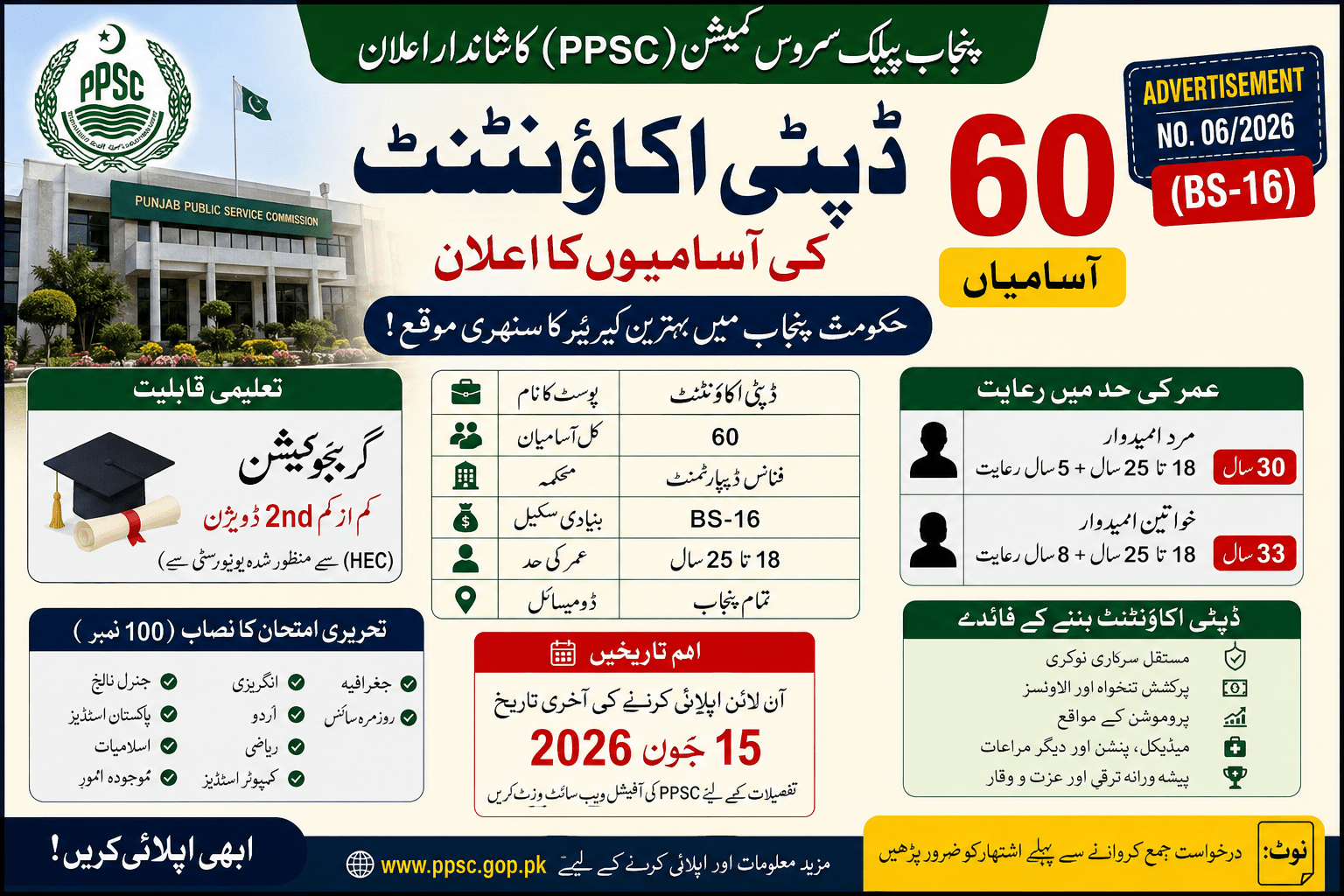
Securing a prestigious government job in Pakistan is a dream for thousands, and the latest advertisement from the Punjab Public Service Commission opens up a massive golden window of opportunity. The highly anticipated deputy accountant ppsc positions have been officially announced, sending a wave of excitement across commerce and finance graduates throughout the province. If you have been looking for a stable career with an excellent pay scale, high societal respect, and solid growth potential, this is your ultimate moment to shine. However, with intense competition on the horizon, simply applying will not cut it; you need a flawless, high-yielding strategy to outshine the crowd.
Cracking this competitive exam requires a meticulous blend of core accounting knowledge, sharp analytical abilities, and strong general knowledge skills. Many brilliant candidates miss out simply because they fail to align their preparation with the precise testing patterns of the commission. In this comprehensive guide, we will break down the entire syllabus, analyze past paper trends, and provide you with actionable study techniques. Let’s transform your professional ambitions into reality by dissecting exactly what it takes to master the deputy accountant ppsc screening test and land your dream appointment in the finance department.
📋 Table of Contents
1. Understanding the Deputy Accountant PPSC Job Profile
Before jumping headfirst into books, it is vital to know exactly what you are signing up for. The Deputy Accountant position, operating under the Finance Department of Punjab, carries substantial administrative and financial responsibilities. Individuals selected for these roles manage public funds, oversee budgetary allocations, audit provincial accounts, and ensure absolute transparency in government expenditure. It is a desk job that demands high mathematical accuracy, an eye for technical detail, and absolute integrity.
According to the recent PPSC Advertisement No. 06-2026, these seats are distributed across various quotas, making it highly competitive yet highly rewarding. Working in this capacity places you directly within the bureaucratic machinery, offering structural career paths, timely promotions, and an excellent pension structure upon retirement. Knowing the dignity of this post should serve as your primary driving force throughout long, exhausting nights of intense preparation.
2. Official Syllabus Breakdown: What to Study
The PPSC testing framework for specialized jobs generally divides the paper into two primary distinct portions: the professional qualification subjects and the standard general knowledge syllabus. For this specific job, your academic background in commerce, business administration, or finance takes center stage. Let us look deep into the core modules you must master to secure passing marks well above the competitive threshold.
Core Professional Accounting Topics
The vast majority of your subject-specific multiple-choice questions (MCQs) will come from standard academic courses. You should focus on basic to advanced concepts within these functional domains:
- Financial Accounting: Principles of double-entry bookkeeping, journal entries, preparation of ledger accounts, bank reconciliation statements, and final accounts calculation.
- Auditing Techniques: Internal and external audit mechanisms, vouching methods, verification of balance sheet items, and understanding official audit reports.
- Cost Accounting: Material costing, labor cost distributions, factory overhead allocations, and basic marginal costing rules.
- Business Finance: Time value of money, working capital frameworks, ratios analysis, and interpreting cash flow declarations.
General Knowledge and Ability
Never underestimate the power of the non-academic section. This portion separates the top rankers from the rest of the pack. It evaluates your everyday awareness and intellectual aptitude through multiple micro-disciplines:
- Pakistan Studies and Islamic History basics.
- Current Affairs spanning global conflicts, domestic economic policies, and sports news.
- Everyday Science principles and core logical analytical reasoning.
- Basic computer literacy, including MS Word, PowerPoint, and deep knowledge of MS Excel formulas.
💡 Pro Tip
Spend 70% of your initial study timeline mastering Advanced Excel formulas and basic Auditing standards. PPSC heavily targets these two areas in public sector finance examinations because they are used daily in the actual role.
3. Comparing Academic and General Knowledge Weightage
To plan your preparation logically, you must visual how the marks are traditionally distributed across the examination paper. Balancing your focus areas based on standard commission testing trends guarantees that you do not over-prepare for low-yield topics while ignoring high-weightage sections.
| Test Section | Estimated Marks | Difficulty Level | Primary Focus Areas |
|---|---|---|---|
| Professional Qualification | 80 Marks | Moderate to High | Financial Accounting, Auditing standards, Costing basics, Corporate Laws |
| General Knowledge & Ability | 20 Marks | Moderate | Current Affairs, Pak Studies, General Math, Basic Urdu, English Grammar |
| Computer Skills Special Focus | Integrated in GK | Low to Moderate | MS Excel shortcuts, operating system shortcuts, internet protocols |
4. 7 Strategic Tips to Crack the PPSC Exam
Now that we have established the parameters of the syllabus, let’s step into the ultimate playbook. Preparing for a public service exam is vastly different from passing a regular semester exam at university. Here are seven tactical shifts you must make in your everyday study routine to achieve top marks.
Preparation Pillars Flowchart
Tip 1: Return to Academic Textbooks
Do not rely completely on sub-standard MCQ summary booklets found in the commercial marketplace. Open up your standard B.Com, BBA, or M.Com books on Financial Accounting and Auditing. Read through structural chapters explaining Depreciation methods, Inventory valuation schemes (FIFO/LIFO), and Company Ordinances. Building clear foundational conceptual clarity helps you deduce correct responses even when PPSC presents highly twisted trick questions.
Tip 2: Deconstruct Previous Commission Exam Papers
The commission has a highly noticeable habit of repeating specific questioning patterns. Go through past examinations for senior auditors, accountants, and treasury officials conducted over the last five to seven years. Take note of how questions regarding international financial reporting standards (IFRS) are structured. This exercise provides you with a precise roadmap of the depth required for your revision sessions.
Tip 3: Set Up Time-Bound Practice Mock Drills
Knowing the correct answer is only half the battle; completing 100 questions within the stipulated 90-minute timeline is where many candidates fail. Print standard OMR bubble response sheets at home and simulate genuine exam-room environments. Turn off your mobile notifications, set a strict countdown clock, and practice your marking speed. This builds muscle memory and keeps panic attacks at bay on the actual test day.
Tip 4: Internalize Public Sector Financial Frameworks
Since you are applying to work inside the provincial government machinery, having a functional knowledge of public sector accounting is immensely valuable. Review the structural overview of the Auditor General of Pakistan (AGP) and look up articles explaining how provincial budgets are passed. For broad career guidance resources and professional development patterns, you can check structural articles available at Alvipedia to stay updated with general educational career trends.
Tip 5: Sharpen Your Quantitative Aptitude
The general ability portion contains quick mathematical puzzles that you can solve perfectly if your fundamentals are sharp. Regularly practice basic arithmetic operations, ratio proportions, percentages computation, profit/loss projections, and simple analytical sequence patterns. These are solid, guaranteed marks that you cannot afford to leave on the table.
Tip 6: Master Everyday Digital Tools
Modern public departments run entirely on computers. PPSC has increased the proportion of questions based on MS Office functionalities. Make sure you memorize common keyboard shortcuts (like absolute references in formulas, conditional formatting macros, and navigation hotkeys). Visualizing how a spreadsheet works will make these technical questions incredibly easy to clear.
Tip 7: Adopt a Mindful News Habit
Dedicate 20 minutes every single morning to reading a reputable English newspaper. Focus your attention entirely on the national business page and global geo-political transformations. Keep a dedicated notebook to jot down newly appointed federal cabinet ministers, international monetary fund (IMF) structural loan amounts, and central bank policy interest rates.
5. Pitfalls to Avoid During Multiple Choice Tests
Many incredibly hardworking aspirants fail to clear the baseline merit threshold because they fall into predictable traps during the high-stakes test. Understanding the psychological mechanics of an objective paper is just as crucial as knowing your academic course material inside out.
“Negative marking is the ultimate filter used by public service commissions. It does not just measure your knowledge—it mercilessly tests your discipline and emotional risk management under extreme time constraints.”
To preserve your hard-earned competitive score, actively guard your strategy against these three fatal execution mistakes:
- Blind Guesswork: Remember that every single incorrect response costs you 0.25 marks due to negative marking regulations. If you cannot logically eliminate at least two options, it is statistically wiser to leave the question completely blank.
- Misreading Complex Prompts: Watch out for hidden double negatives or words like “NOT”, “EXCEPT”, or “INCORRECT” placed carefully inside long descriptive questions. Read every sentence slowly from start to finish before choosing your option.
- Poor OMR Sheet Management: Waiting until the final five minutes to fill out all 100 bubbles on your answer sheet is dangerous. A single alignment error can shift your entire sequence down by one row, instantly ruining your whole paper. Fill them in steady, organized blocks of ten.
6. Conclusion
Landing a coveted deputy accountant ppsc seat is a life-altering professional milestone that brings immense career stability, high status, and a unique platform to serve the public sector. While the extensive syllabus and competitive pressure might seem overwhelming at first, breaking your preparation down into structured, daily goals turns it into a completely manageable task. Focus on mastering your core academic financial concepts, stay disciplined with past papers, and treat general knowledge as an essential daily habit rather than an afterthought. Believe in your preparation strategy, maintain a calm head during your study sessions, and approach the examination hall with confidence. Your dedicated hard work will yield excellent results—go put in the effort and claim your success!
7. Frequently Asked Questions (FAQs)
Q1: What is the exact qualification required for the Deputy Accountant post?
Candidates typically require a minimum Second Class Bachelor’s degree in Commerce (B.Com), Business Administration (BBA Finance), or related financial disciplines from an HEC-recognized university.
Q2: Does PPSC apply negative marking to this screening paper?
Yes, a penalty deduction of 0.25 marks is automatically applied for every wrong answer marked on the OMR sheet, so you should avoid blind guesswork.
Q3: How many marks are required to qualify for the interview phase?
While the baseline passing score is 40%, the actual qualifying cut-off varies depending on the number of open seats and overall candidate performance metrics.
Q4: Can I use a scientific financial calculator during the test?
No, calculators and electronic smart devices are strictly prohibited inside the commission examination centers. All mathematical questions must be calculated manually.